RESEARCH AND COMMUNITY VOICES · By HumanScope Research
When we say a programme worked, whose idea of success are we using?
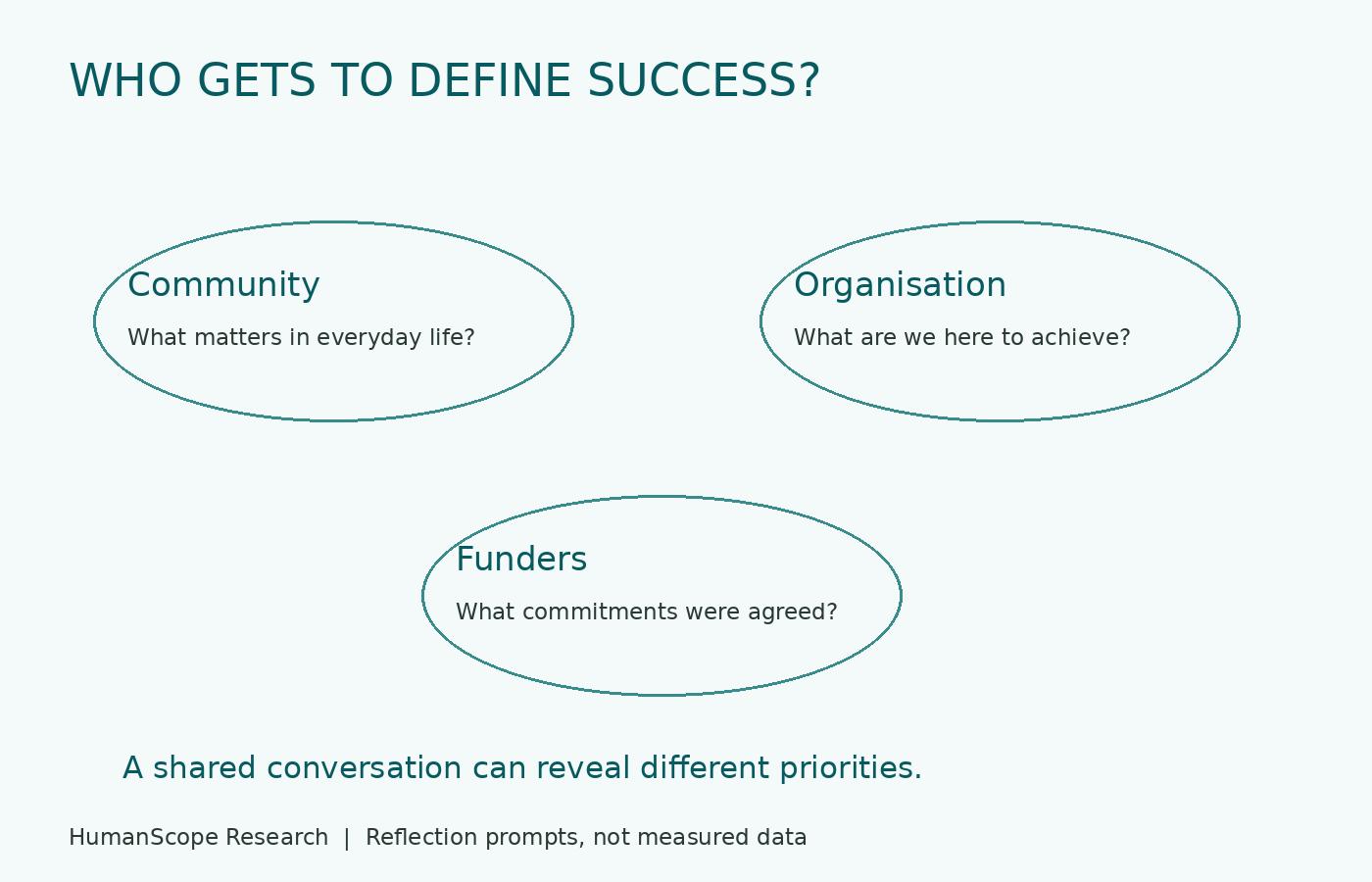
A funder may be looking for an agreed milestone. A team may be pleased that people kept coming. A participant may care most about feeling able to ask for help without embarrassment.
All three perspectives can matter. The difficulty begins when one quietly becomes the whole definition.
One programme, different hopes
Imagine a community learning group. This is an illustrative example, not a client story. The organisation hopes people will gain practical skills. A participant hopes to feel comfortable speaking in a room of strangers. A family member hopes those skills will make an everyday task less stressful.
The programme may address all of these hopes. Or it may have been designed for only one. Until the differences are discussed, everyone can use the same word, success, while imagining something different.
That is a question about meaning before it is a question about measurement.
Community input can shape what is being assessed
A New Zealand example appears in the Public Service Commission’s case study of community engagement in eastern Porirua. One stated objective was for the community to understand how their input had shaped the framework used to monitor the project’s success.
Read the eastern Porirua engagement objectives
That is a specific example from an urban development project, rather than a universal evaluation rule. It offers a useful prompt for other settings: can people see how their priorities influenced the definition of progress?
Asking for feedback after decisions have been made is different from making room for people to influence what those decisions aim to achieve.

A shared definition does not require identical priorities
Listening may reveal disagreement. One person values independence. Another wants more reliable support. A service may need to balance both, while staying within its purpose and resources.
Community voice also includes differences within a community. A confident speaker’s preference cannot automatically stand for everyone. Cultural understandings, disability, age and everyday circumstances may affect what people hope a service will make possible.
In Aotearoa, questions involving Māori communities deserve attention to whose aspirations are being expressed and how mana whenua and whānau wish to participate. A broad label such as community wellbeing does not explain those priorities by itself.
What does the report leave room to recognise?
If the agreed picture of success is narrow, an evaluation may overlook a change that matters to participants. If it is so broad that anything counts, it may be difficult to say what the programme achieved.
The useful tension lies between clarity and openness. Can the organisation explain its purpose while remaining curious about how people experience it? Can unexpected benefits and unmet hopes be discussed alongside agreed commitments?
An honest conversation might reveal that the organisation’s definition still fits. It might reveal that the language needs to change. Either way, that understanding gives the next decision a better starting point.
An invitation to look again
Think about the last time your team described a programme as successful. Would participants recognise themselves in that description? Would they add something you had not considered?
HumanScope supports research, evaluation and outcomes work that connects organisational questions with community perspectives. If your team is reconsidering what success means, we welcome a conversation about your priorities.
Register your interest in research and outcomes
Visuals are conceptual illustrations. The infographic presents perspectives for discussion, not measured data.