

A funding application captures a particular moment. The need is understood in a certain way. Costs are estimated. Delivery is planned. People make careful promises about what the work will achieve.
Then real life keeps moving.
A venue becomes unavailable. Referrals arrive from a group the service did not expect to reach. A partner organisation changes direction. The original activity is still valuable, but the timing, format or mix of costs no longer fits as neatly as it did on application day.
The important question is not whether the plan changed. It is whether the organisation can explain what changed, protect the purpose of the grant and involve the funder before making a different commitment.
A plan is a promise made with the knowledge available
Funding agreements matter. They give both parties a shared understanding of purpose, activity, cost and accountability. Yet a plan can be both carefully prepared and overtaken by circumstances.
Community Matters states that Lottery grant funding must be used for its approved purpose and listed expenses, and that prior approval is needed if an organisation wants to use it for a different purpose. Its guidance for the Community Organisation Grants Scheme also says that when things have changed, organisations need to discuss this with an advisor. These are practical reminders that adaptation and accountability belong in the same conversation.
Change is not automatically a sign of poor planning
Sometimes a change exposes a weakness in the original design. Sometimes it reflects new information that could not reasonably have been known. Often it is a mixture of both.
The useful distinction is between a plan that has drifted without attention and a plan that is being reconsidered openly because the context has moved.

An illustrative example
Imagine a community organisation funded to run a sequence of evening workshops. This example is hypothetical. After the grant is approved, the organisation learns that many intended participants can only attend during school hours because transport and caring arrangements have changed.
The community need has not disappeared. The original purpose may still be sound. But simply shifting the timetable could affect venue costs, staffing and the group that can participate. The organisation now has several questions to hold at once.
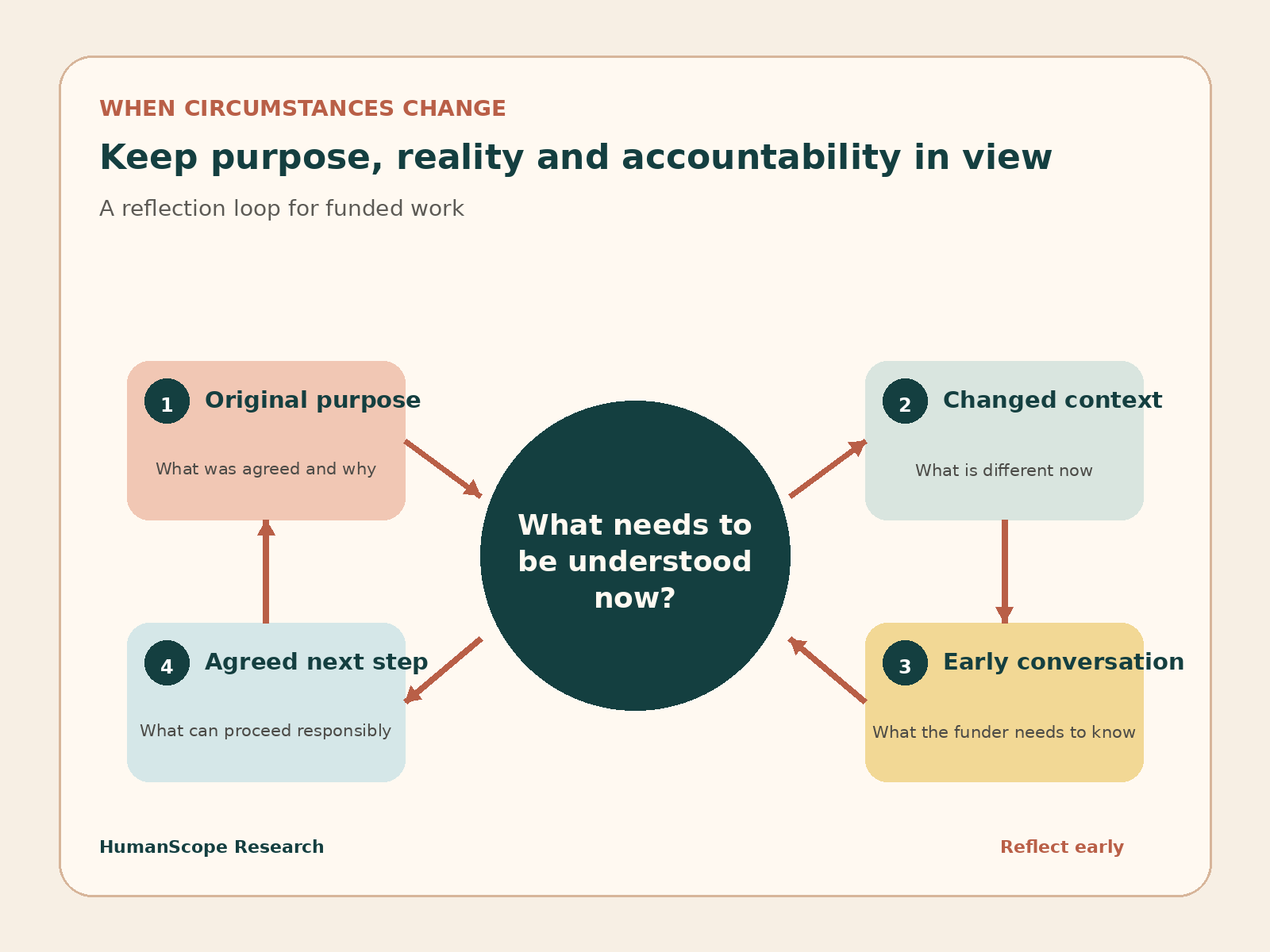
What has changed in the community context?
What remains true about the purpose that was funded?
Would the proposed response alter the approved activity, budget or conditions?
What does the funder need to understand before a decision is made?
These questions do not produce an automatic answer. They create a more honest basis for a conversation.
Early conversation is part of good stewardship
Organisations can feel pressure to wait until they have a polished solution before contacting a funder. That instinct is understandable. No one wants to appear uncertain.
Yet silence can turn a manageable change into a reporting surprise. An early conversation can clarify which parts of the agreement are fixed, which parts may be varied and what information will support a responsible decision.
It can also reveal that the organisation and funder are seeing the same situation differently. The organisation may be focused on community access. The funder may need assurance about scope, fairness or the use of public money. Neither perspective disappears because the other is important.
Flexibility is not the same as vagueness
A flexible response still needs a clear reason. It should connect back to the intended community benefit and make the practical implications visible. What would change? What would stay the same? Who might benefit or miss out? What would the organisation need to monitor differently?
Those questions are more useful than treating the original application as either untouchable or optional.
The deeper sustainability question
When an organisation can talk openly about changed circumstances, it is doing more than protecting one grant. It is strengthening the habits that support sustainable work: shared knowledge, realistic planning, timely communication and decisions that stay connected to community need.
A resilient organisation does not pretend that every forecast was perfect. It notices early, thinks carefully and remains accountable while reality changes.
A question to take back to your team
If one important assumption in your current funded plan changed tomorrow, would your team know what to notice, who to involve and which conversation to begin?
HumanScope Research helps community organisations think through funding choices, sustainability and the story behind changing work without losing sight of accountability.
Sources and further reading
Community Matters: Can I change the purpose of my Lottery grant?
Community Matters: Community Organisation Grants Scheme