

A budget can add up neatly and an organisation can still feel one difficult month away from strain.
Income matches planned spending. The board receives a clear report. The year may even be forecast to end without a deficit. Yet staff are covering gaps through extra effort, a key system needs replacing, grant payments arrive after costs fall due and there is little room for an unexpected expense.
Nothing in the total is necessarily wrong. The total is simply not the whole picture.
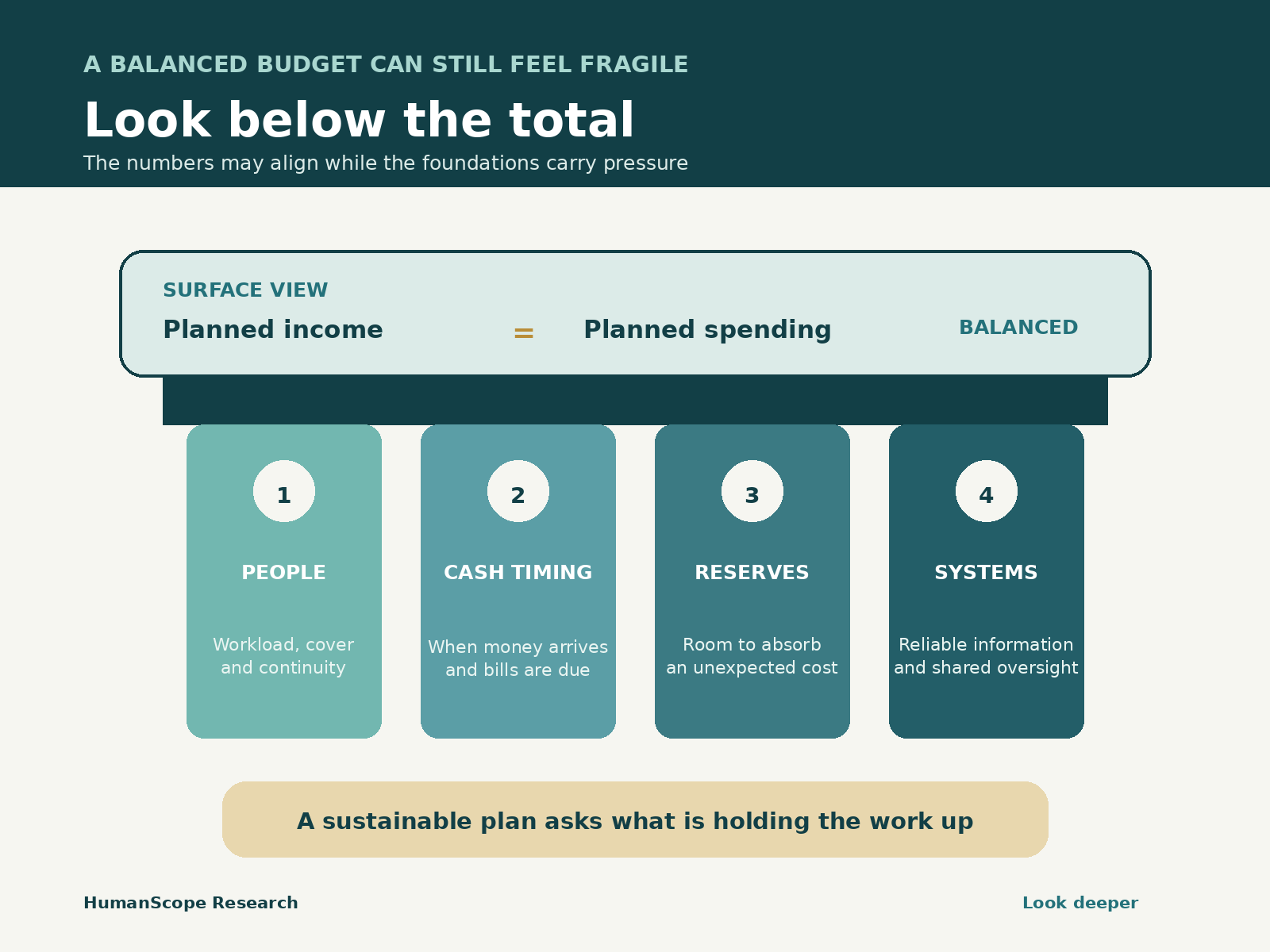
A balanced budget describes an important relationship between income and spending. Sustainability asks whether the people, timing, reserves and systems beneath that relationship can keep carrying the work.
Balance is a snapshot
Budgets are essential. They help an organisation decide how resources will be used, compare plans with reality and make choices before pressure becomes a crisis.
But a budget is organised around categories and time periods. It may not reveal how much extra effort is holding delivery together, how dependent the organisation is on one person or how long essential maintenance has been postponed.
Charities Services says officers are responsible for the financial sustainability of their organisation and for ensuring funds and assets advance its charitable purposes. Its current governance guidance also identifies budget approval, monitoring income and spending, reviewing financial reports and managing risks as core responsibilities.
That points to a wider conversation. Financial stewardship is not only about whether the columns agree. It is also about whether decision makers can see the conditions behind the figures.
What the numbers may not show
A balanced plan may depend on a vacancy remaining unfilled. It may assume that a manager continues doing two roles. It may leave no room for staff development, equipment replacement or a temporary drop in income.
Each choice may be understandable in isolation. Together they can make the organisation more fragile.

An illustrative example
Imagine a small community service preparing a budget for the coming year. This example is hypothetical. Confirmed grants cover programme delivery, rent and the hours currently allocated to staff. On paper, income and spending are equal.
The plan also assumes that one experienced coordinator will continue managing referrals, reporting, volunteer support and relationships with partner agencies. The service vehicle is becoming unreliable, but replacement is deferred. One grant is paid after the programme must begin, so general funds will need to carry the first costs.
The budget balances. The work is still exposed.
The useful question is not whether the budget should show a deficit instead. It is what the balanced total is asking the organisation to absorb.
Fragility often appears around the figures
It can appear in repeated signs: leave that is difficult to cover, invoices delayed while a payment is awaited, reporting knowledge held by one person or equipment kept in use beyond the point where staff feel confident in it.
These are not always accounting errors. They are organisational signals with financial consequences.
When they are discussed only as operational inconveniences, the board may miss how much risk sits beneath a balanced plan. When they are discussed only as financial matters, the human and service consequences may disappear.
A healthier conversation connects the layers
What work is currently being carried through goodwill or extra effort?
Which costs have been delayed rather than removed?
Where does the timing of income create pressure even when annual income is sufficient?
What knowledge, relationship or responsibility depends too heavily on one person?
If one assumption changed, what would the organisation protect first?
These questions do not replace financial reporting. They help people read it with a clearer understanding of how the organisation actually operates.
Sustainability may begin with permission to name pressure
Community organisations are often skilled at making limited resources stretch. That capability matters. It can also make strain look normal.
Naming fragility is not the same as saying the organisation is failing. It creates the possibility of a more realistic funding story, a better informed governance decision and a clearer conversation about what the work truly requires.
If the budget balances only because people, systems or future needs are absorbing the difference, what would become visible if that hidden contribution were named?
HumanScope Research helps community organisations connect funding decisions with the wider conditions needed to sustain their work.
Sources and further reading
Charities Services: Governance for charities
Charities Services: Financial management