

By HumanScope Research
The feedback is lovely. People felt welcome. The facilitator was engaging. Several respondents say they would recommend the programme.
Of course the team is pleased. They put care into the work, and it is good to hear that people noticed.
Then someone asks: did the programme help people do what they came to do?
The feedback sheet may not answer that question.
Enjoying something and benefiting from it
Imagine a community workshop intended to help people feel more confident dealing with everyday digital tasks. Participants enjoy the session and appreciate the patient tutor. This is an illustrative example, not a client story or a research finding.
A week later, one participant can complete a task independently. Another still needs help, despite enjoying the workshop. Someone else has the skills but no reliable access to a device.
Their positive feedback could be equally sincere. Their experiences afterwards could be quite different.
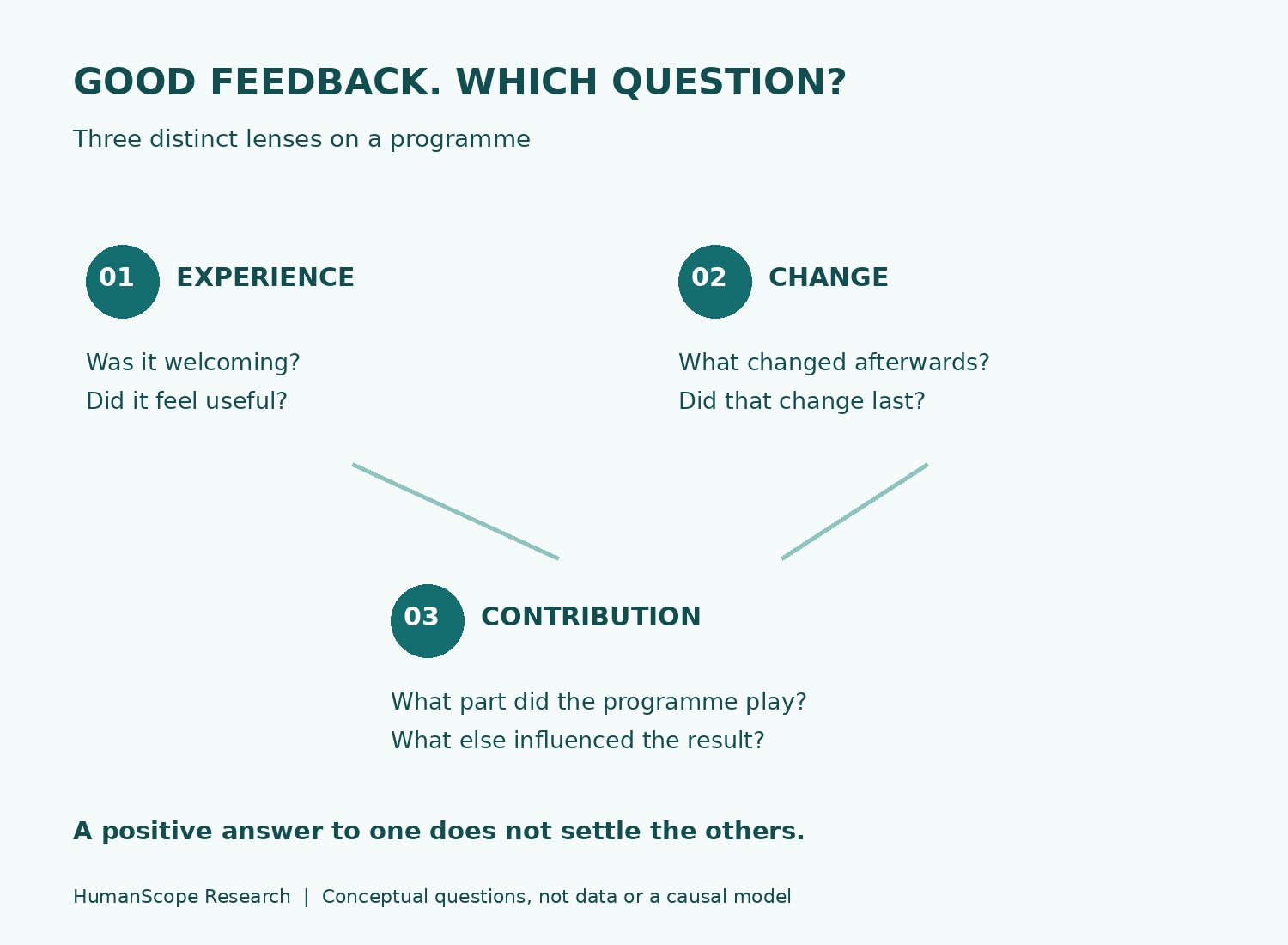
That is why we would hesitate to turn ‘people liked the session’ into ‘the programme achieved its purpose’. The first statement may be supported. The second asks for different evidence.

Give good feedback its proper place
Warmth, respect and a sense of safety are worth understanding. Positive feedback can tell an organisation something valuable about how a service was experienced.
It can also be the beginning of a better question. What did people find useful? Useful for what? Were they able to use it when they needed it?
New Zealand’s social sector handbook, Making sense of evaluation, distinguishes how a programme is delivered from the outcomes it achieves. It also asks how we know a change came from the programme rather than something else. For our workshop example, this means asking separate questions about the experience, what happened afterwards and the programme’s contribution.
Read Making sense of evaluation, a New Zealand social sector handbook
The answer may unfold later
Some benefits are immediate. Others take time to appear, and some may not appear at all.
In the imagined workshop, a participant might need another opportunity to practise before feeling confident. A favourable response at the end of the session would not reveal that later experience.
Timing shapes what we can reasonably say. So does context. A person may learn something useful but be unable to act on it because of barriers the programme cannot remove.
That possibility deserves curiosity. It does not make their praise meaningless, or automatically make the programme a failure.
Leave room for an answer you did not expect
A team can care deeply about its work and still discover that a programme helped in a different way from the one it intended.
Perhaps people valued companionship more than the formal content. Perhaps the content was useful but the pace made it difficult to apply. These are possibilities to explore, not conclusions to assume.
If every report is expected to end with a success story, there may be little room to talk about that difference. Honest learning needs room for the mixed answer.
A fuller conversation about success
Before sharing the next glowing comment, pause over what it supports. It might be evidence of a welcoming experience, an insight into a particular person’s priorities, or a starting point for further enquiry.
Being precise does not drain the warmth from the feedback. It helps an organisation value the praise while understanding what it still needs to learn.
HumanScope Research supports programme evaluation, outcome measurement and community research. We help organisations make sense of what their evidence can say, beginning with a scope that fits their needs.
Register your interest in research and outcomes support
HumanScope Research. Understanding people. Strengthening impact.