

FUNDING AND SUSTAINABILITY · By HumanScope Research
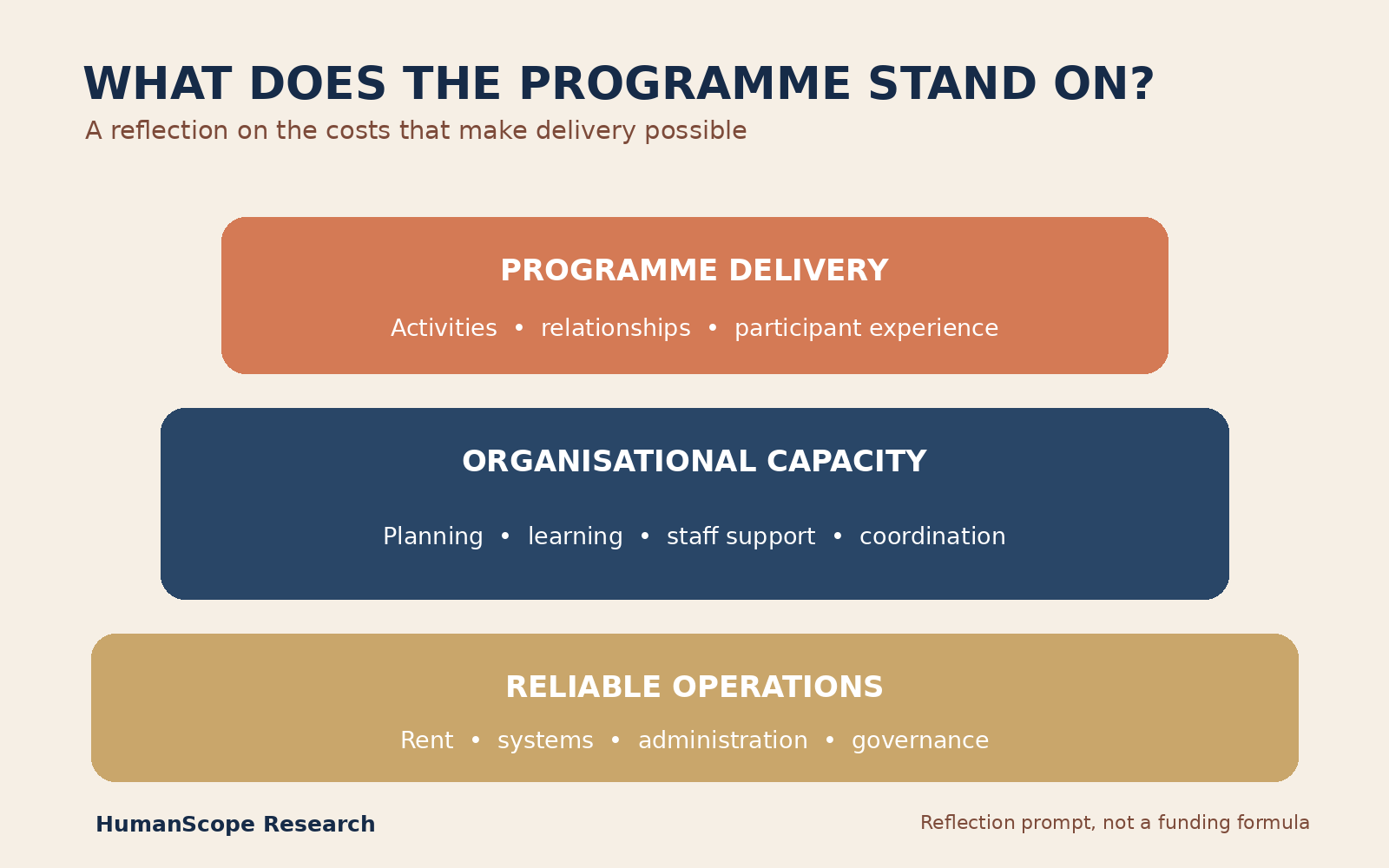
A programme is easy to picture. There are sessions, people, materials and a clear purpose. The organisation that makes it possible can be harder to see.
Someone keeps the premises open. Someone supports staff, maintains the records, answers enquiries, checks the budget and notices when a small operational problem is becoming a larger risk. These activities may sit outside the programme description, but the programme still depends on them.
What happens when funding supports the visible activity but leaves its foundations fragile?
The programme does not deliver itself
Imagine a community organisation running a weekly support programme. This is an illustrative example, not a client story. The grant covers the facilitator, venue hire for each session and participant resources.
The programme appears fully funded. Yet the organisation also needs time to coordinate referrals, respond to safeguarding concerns, maintain its information systems, support the facilitator and prepare the space. The printer fails. Insurance renews. A board member needs accurate information before approving a decision.
None of these tasks is the programme on its own. Together, they make reliable delivery possible.

Operational costs are real programme conditions
Community Matters distinguishes between ongoing operational costs and costs for a defined one off project. Its current budget guidance lists salaries, administration, rent, regular programme delivery, events, repairs and maintenance among examples of operational costs.
That distinction matters. It reminds us that an organisation has a continuing life around each funded activity. A project may have a clear start and finish, while rent, leadership, systems and staff support continue across the whole year.
Read Community Matters guidance on budgets
Not every essential cost belongs neatly to one programme
Some costs can be assigned directly. Others support several activities at once. A secure client record system may serve every programme. A manager may spend one hour helping a facilitator think through a difficult situation, then another hour preparing information for the board.
Trying to make every shared cost disappear into a narrow programme line can create a misleading picture. It may suggest that delivery is separate from the organisation that holds responsibility for it.
A funding conversation can reveal what has been normalised
In the imagined organisation, the team may have become used to filling gaps with unpaid time, delayed maintenance or one person carrying several roles. Because delivery continues, these arrangements can look sustainable from the outside.
Continuity is not always evidence that the foundations are strong. Sometimes it shows how much people are quietly absorbing.
Charities Services says charity officers are responsible for the financial sustainability of their organisation and for ensuring funds and assets advance its charitable purposes. Its guidance also emphasises accurate and transparent accounting and reporting systems.
Read Charities Services guidance on financial management
What deserves to be visible?
This is not an argument that every fund should cover every organisational cost. Funding purposes and eligibility rules differ. It is an invitation to make the real conditions of delivery easier to discuss.
When a programme budget is prepared, what shared capacity does the activity rely on? Which costs are genuinely covered elsewhere? Which depend on goodwill or postponed work? And what would reliable delivery require if the programme continued for another year?
Those questions can help an organisation describe its position honestly without treating its internal arrangements as a failure. They can also clarify which opportunities fit the organisation and which would add activity without strengthening the conditions around it.
HumanScope supports funding research and sustainability work that connects opportunities with organisational purpose, evidence and practical capacity. If your team is considering what sits beneath programme delivery, we welcome an enquiry.
Register your interest in funding support
HumanScope Research. Understanding people. Strengthening impact.
Images are conceptual editorial photographs. The infographic presents reflection prompts, not a funding formula. Sources checked 8 October 2026.