

RESEARCH AND COMMUNITY VOICES · By HumanScope Research
A service can be delivered exactly as planned and still become less useful over time.
The timetable is familiar. The referral pathway is clear. Staff know what happens next. Consistency can feel reassuring, especially when a team has worked hard to create it.
Meanwhile, people’s lives keep moving. Work patterns change. Transport becomes harder. New families arrive. Trust grows in one place and weakens in another. A service can stay steady while the context around it shifts.
How would we know if the service is still meeting the need it was designed for?
A good service can drift away from its purpose
Imagine a community drop in service that opens on weekday mornings. This is an illustrative example, not a client story. When it began, the time suited many people who used it. Attendance was steady and the team developed a reliable routine.
Two years later, several local employers have changed their shifts and more families are managing complex caring responsibilities. The service remains welcoming. Staff are still skilled. Yet fewer people can arrive during the opening hours.
A fall in attendance could have several explanations. It does not prove that needs have disappeared or that the service is poor. It creates a question worth exploring.
Consistency can hide a changing fit
Organisations often need routines. People deserve to know when a service is available and what they can expect. The risk appears when the routine becomes evidence of relevance simply because it has continued.
The Department of the Prime Minister and Cabinet describes evaluation as a way to measure and understand the effectiveness of programmes. Its guidance also asks whether outcomes improved and, if not, why not and what could be done.
Read the Department of the Prime Minister and Cabinet evaluation handbook
These are not questions reserved for the end of a programme. They can support a thoughtful pause while delivery is still happening.

Notice change before trying to explain it
In the imagined drop in service, the team might notice different patterns. Some people arrive late. Others ask for help by phone. A group that once attended regularly is now rarely present. Staff hear that the need remains, but the pathway into the service feels less possible.
Each observation is partial. None should be turned into a conclusion on its own. Together, they can suggest where a deeper conversation belongs.
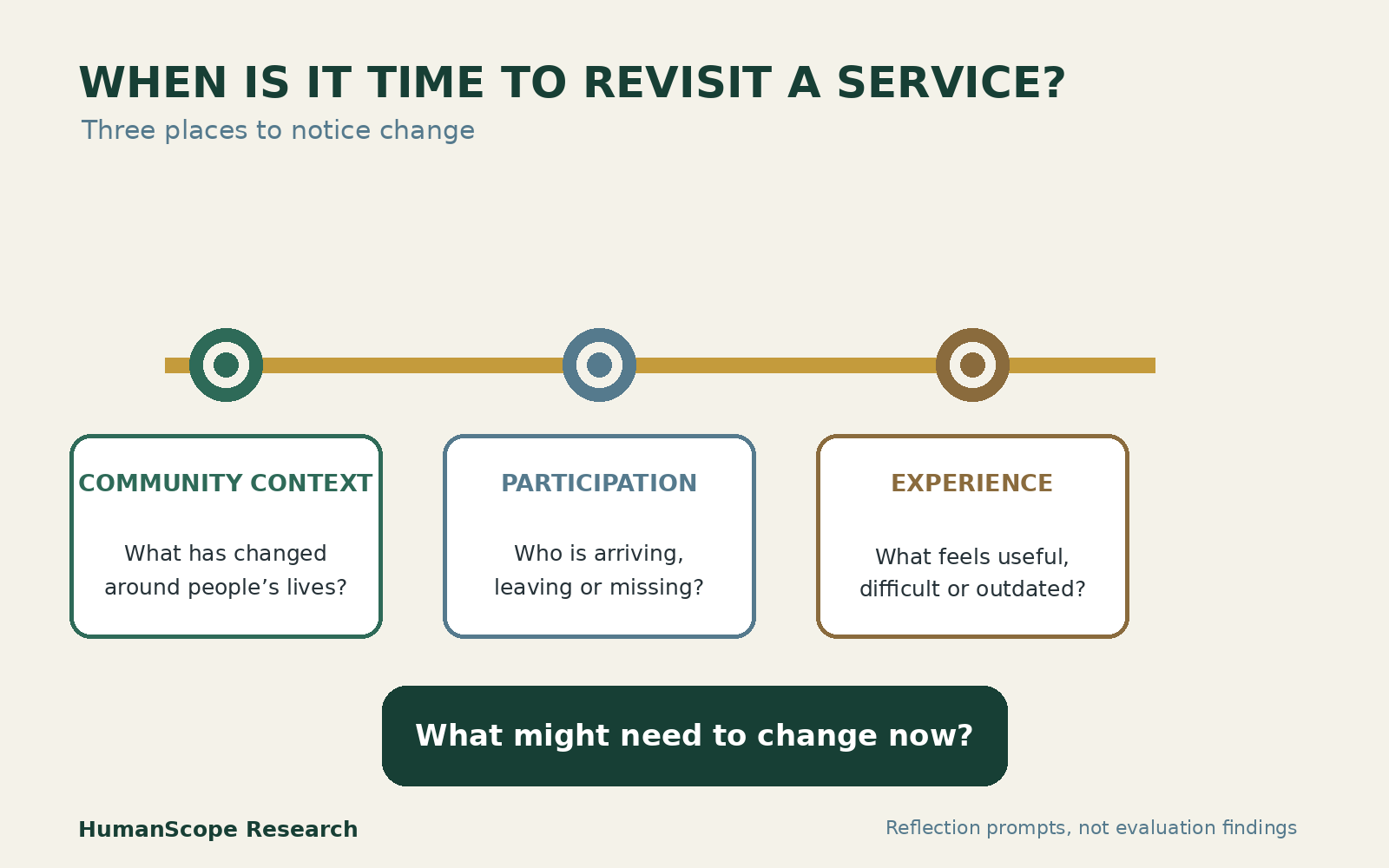
Useful evidence may come from several places: participation patterns, staff observations, community conversations, referral information and the experiences of people who did not use the service. The aim is not to gather everything. It is to understand enough to reconsider the fit.
Whose experience has changed?
Community need is rarely one moving line. A service may work better for one group and become harder to reach for another. An overall attendance total can conceal those differences.
The DPMC guide on using evidence recommends a structured approach across programme development and evaluation. It also highlights the importance of different cultural values and knowledge systems, and of being transparent about how evidence has been considered.
Read the Department of the Prime Minister and Cabinet guide to using evidence
For a community organisation, that can prompt a practical question: whose knowledge would change our interpretation of what we are seeing?
Adaptation is not an admission of failure
Changing a service can feel risky. People may worry that revisiting the model questions earlier decisions or unsettles something valued by the community.
Yet adaptation can also be a sign that an organisation is paying attention. The original design may have been right for its time. The next version may need to respond to a different time.
The answer may not be a complete redesign. It could be a conversation about timing, access, communication or who helps shape the next decision. The important point is not to assume that staying the same is neutral.
A question for the next service review
Choose one part of the service that has not changed for a while. What need was it designed to meet? What evidence suggests that need, and the way people experience it, is the same now? What evidence might complicate that picture?
A service does not have to chase every change. It does need a way to notice when the distance between its design and people’s lives is growing.
HumanScope supports community research, evaluation and outcomes work that helps organisations connect evidence with thoughtful decisions. If your team is reconsidering whether a service still fits, we welcome an enquiry.
Register your interest in research and outcomes support
HumanScope Research. Understanding people. Strengthening impact.
Images are conceptual documentary photographs. The infographic presents reflection prompts, not evaluation findings. Sources checked 8 October 2026.