

FUNDING & SUSTAINABILITY
The final report is submitted. The budget is reconciled. On paper, the project is complete.
For the people who used the service, the ending may feel quite different.
Imagine a small weekly group where people have begun to feel comfortable asking for help. This is an illustrative example, not a client story. By the final session, someone who barely spoke at the beginning is staying behind for a conversation. Another person has finally found somewhere they feel welcome.
Then the funding period ends.
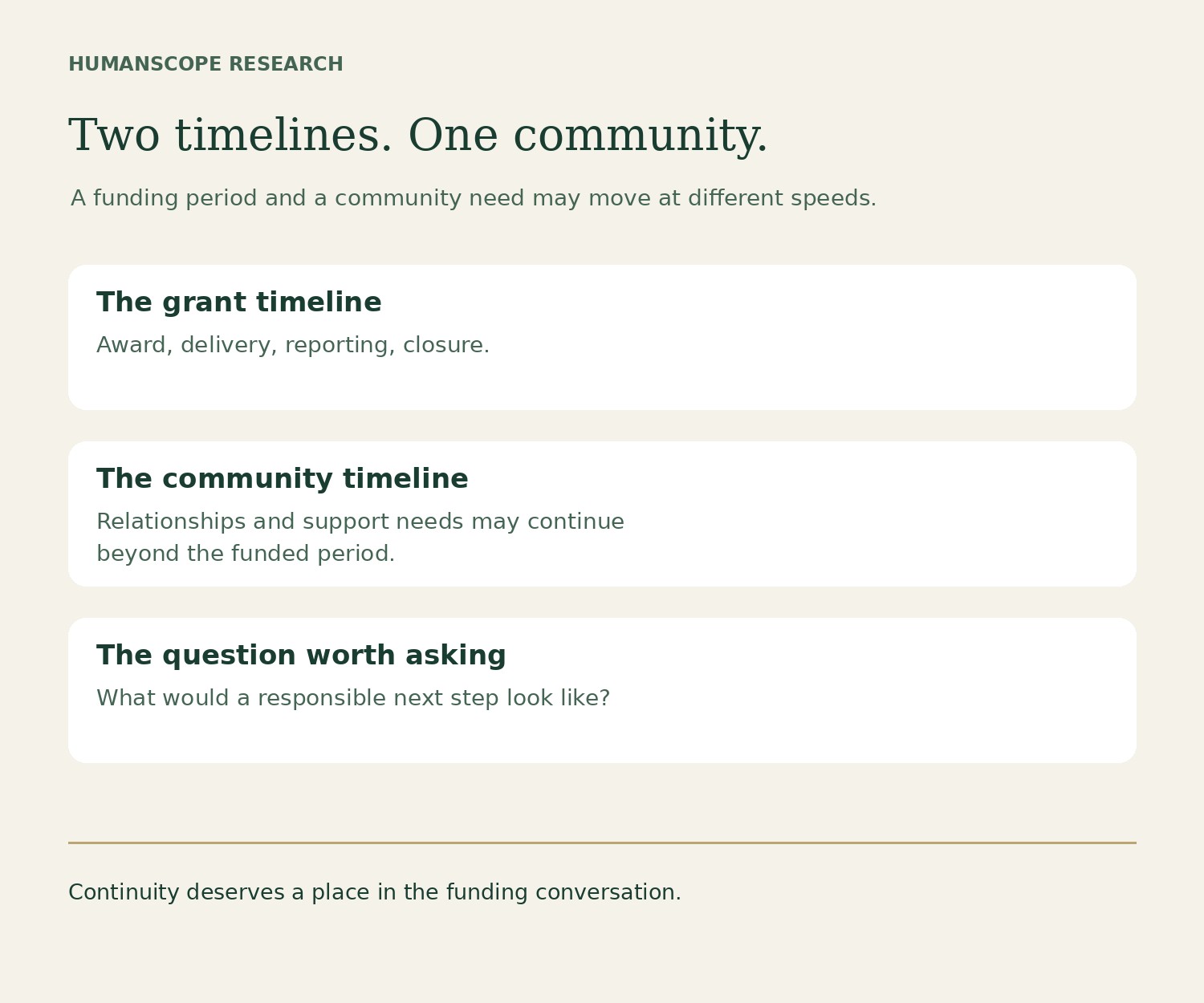
The grant has reached its closing date. The need for connection may still be there.
A programme has an end date. A relationship may not.
Temporary funding can create valuable opportunities. It can make room to test an idea, respond to an immediate need or reach people an organisation has struggled to support.
The difficulty comes when a service begins to matter in ways that extend beyond its original timetable.
People do not experience support as a sequence of funding rounds. They experience a familiar place, a reliable person, a conversation they can return to.
That is why the end of a programme deserves attention well before its last session.
What does an ending ask of a small organisation?
A team may be weighing several uncomfortable choices: reduce the service, find another source of support, refer people elsewhere or close it altogether.
Keeping a programme running without sufficient resources can put pressure on staff, volunteers and the organisation itself. Continuing at any cost is not a sustainable answer.
Equally, a service ending on schedule does not tell us whether people have somewhere appropriate to go next.
The useful conversation is about what a responsible transition would mean for this particular community.

Continuity is worth talking about
We would like to see more funding conversations make room for what happens afterwards.
That might mean acknowledging an ongoing need, allowing time for a careful transition or asking what has been learned before deciding whether a service should continue.
It also means being honest with participants. Uncertain funding should not become a promise that an organisation cannot keep.
Sometimes a programme should end. Sometimes it needs to change. Sometimes the evidence supports a stronger case for continued investment. Those are different conclusions, and they deserve thoughtful consideration.
The question after the final report
When we ask whether a funded project succeeded, it is worth asking one more question: what happened to the people when it finished?
That question brings the funding conversation back to the lives the programme was intended to support.
HumanScope Research helps community organisations explore needs, understand outcomes and build a clearer case for future funding and sustainability.
Talk to us about funding and sustainability
HumanScope Research. Understanding people. Strengthening impact.