

Asking for feedback creates an expectation.
People take time to remember, explain and sometimes share experiences that are personal or difficult. They may complete a survey, join a hui, speak in an interview or offer a comment after a programme.
Then they wait.
If nothing returns, they may never know whether their contribution was heard, whether it influenced a decision or whether the organisation simply moved on to the next consultation.
Collecting feedback is not the end of a conversation. The relationship continues through what the organisation acknowledges, explains and brings back.
Feedback is part of participation
The Department of the Prime Minister and Cabinet describes community engagement as involving people affected by a decision or interested in an issue in policy design, development and decision making. Its guidance describes a range from providing information and asking for feedback through to collaboration and shared decision making.
That range reminds us that not every feedback process offers the same influence. A short survey may inform a service improvement. A community design process may give people a much stronger role.
Whatever the level, clarity matters. People should not have to guess what was being asked of them or what happened afterward.
An illustrative example
Imagine a community organisation asking families about the timing and location of a weekly service. This example is hypothetical. Many families ask for a second location. Others say that changing the current venue would make access harder. The organisation cannot afford to operate both sites.
The team reviews the feedback and keeps the current location. It also changes the session time and arranges a limited transport option. These decisions are thoughtful, but the organisation never tells families what it heard or why the final choice was made.
From inside the organisation, the feedback shaped the decision. From outside, it may look as though nothing happened.

A response does not have to promise agreement
Closing the loop does not mean doing everything people requested. Organisations face real limits involving funding, safety, capacity, purpose and competing needs.
A useful response can still acknowledge what was heard, explain the decision, name what will change and be honest about what cannot change now.
That explanation may be more respectful than a broad message saying that feedback was valuable without showing where it went.
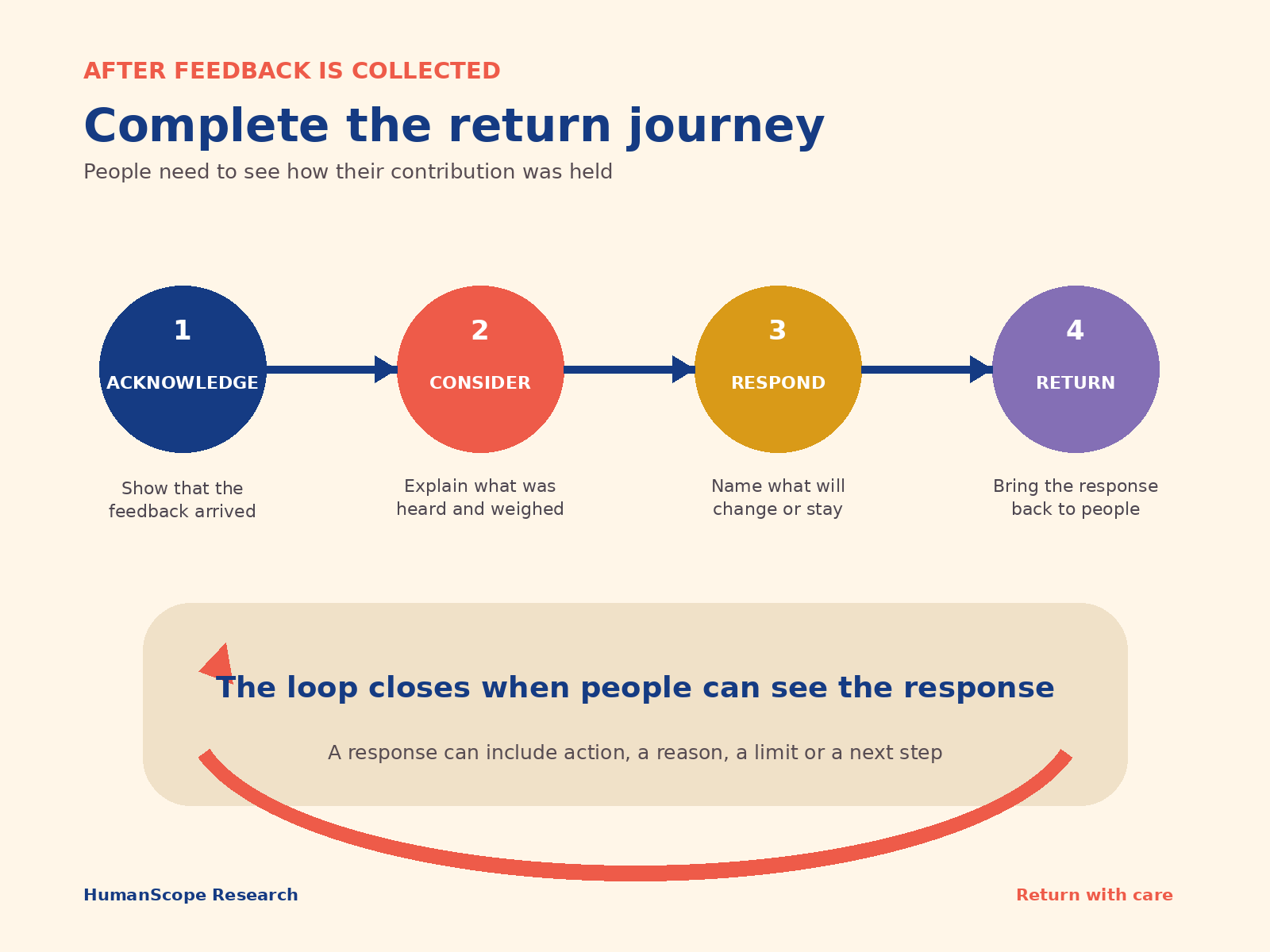
The return journey has several forms
Sometimes the response is a short update on a noticeboard or website. Sometimes it is a conversation at the next community gathering. Sometimes different groups need different formats, languages or levels of detail.
The form matters less than whether people can recognise the connection between what was shared and what happened next.
A response may include action. It may include a reason for keeping something unchanged. It may identify a question that needs more investigation. It may also explain when the organisation will return with a fuller answer.
Silence can alter future feedback
When people repeatedly offer their views without seeing a response, the next invitation may feel less meaningful. Participation can begin to look like extraction rather than relationship.
The reverse is also possible. When an organisation returns with care, people can see that their time was taken seriously even when the final decision differs from their preference.
This does not guarantee trust. It supports the conditions in which trust can grow.
Who can access the response?
Publishing an update online may reach some participants and miss others entirely. A response placed in the service room may not reach people who stopped attending. A long report may be technically complete and practically inaccessible.
It helps to ask where people originally engaged, what communication channels they use and what barriers may affect their access to the response.
The Department of the Prime Minister and Cabinet checklist for public consultation explicitly includes closing the consultation feedback loop with the public. That principle is valuable beyond government. If people were invited into the conversation, the organisation should consider how the conversation returns to them.
Questions to carry forward
What did people understand their feedback would influence?
Can they see what was heard, not only what was decided?
Have we explained the limits around the decision honestly?
Who may miss the response if we use only our usual communication channel?
What promise, if any, are we making about the next step?
A feedback process becomes more complete when people can trace a line from their contribution to the organisation’s response.
HumanScope Research supports community organisations to gather, interpret and communicate community insight with clarity and care.
Register for research and outcomes support
Sources and further reading
Department of the Prime Minister and Cabinet: Community engagement
Department of the Prime Minister and Cabinet: Long term Insights Briefings checklists