

FUNDING AND SUSTAINABILITY · By HumanScope Research
The email arrives after weeks of preparation. Your funding request has been declined. Someone closes the laptop. Another person asks what the organisation did wrong.
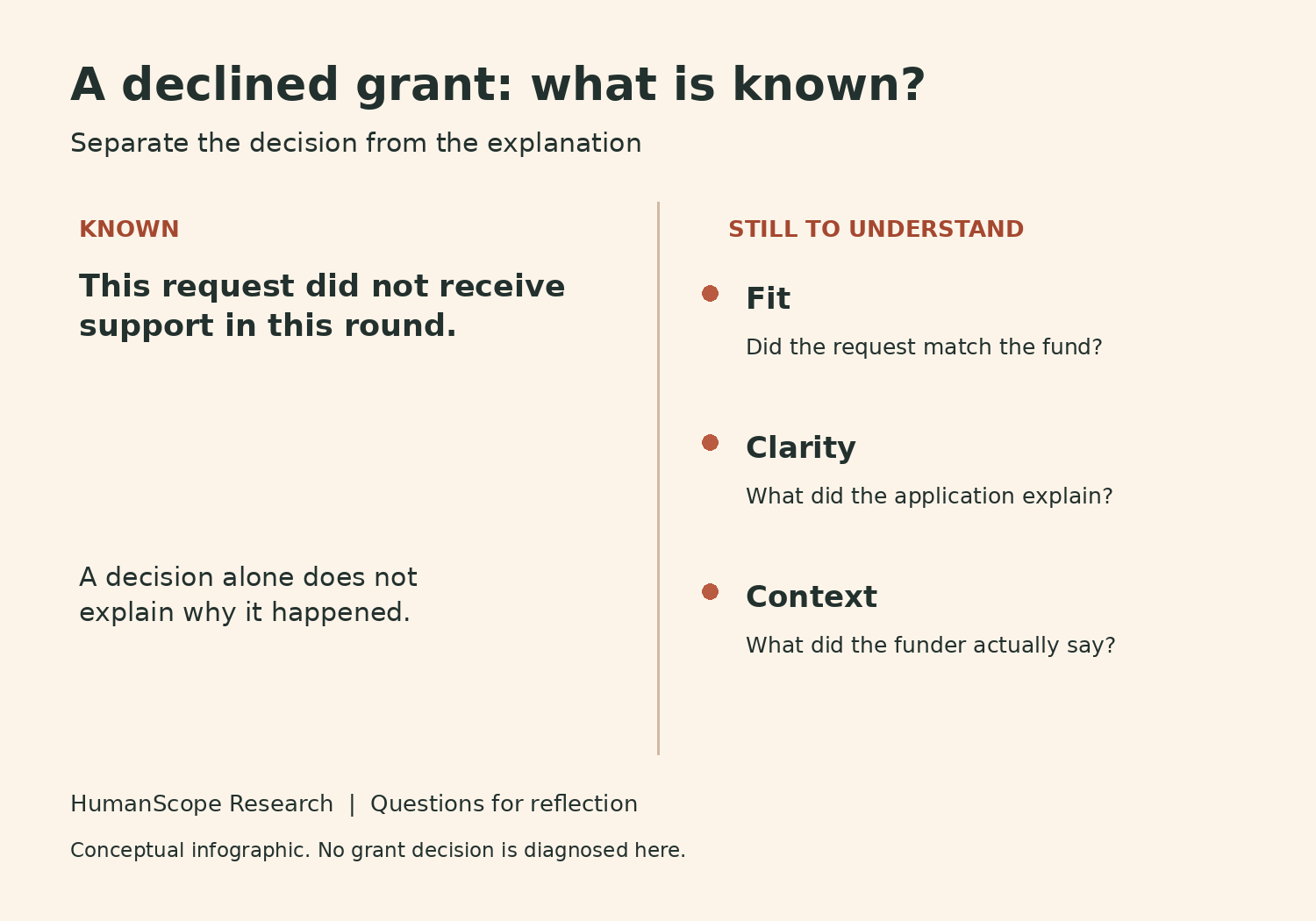
That question is understandable. It may also be wider than the decision can answer. A declined application tells us that this request did not receive support in this round. Without further information, it does not explain why.
A decision is not a diagnosis
Imagine a neighbourhood organisation applying for support for a new family programme. This is an illustrative example, not a client story. The team knows families want the service and has put care into the proposal. The application is declined, with only a short notification.
Perhaps the request did not fit a priority. Perhaps part of the explanation was unclear. Perhaps the fund had other commitments. These are possibilities, not findings. Choosing one because it feels convincing can send the next application in the wrong direction.
It would be equally unhelpful to conclude that nothing could improve. The useful starting point is to distinguish what the funder actually said from what the team is filling in.
What do we know about this decision, and what are we assuming?
Read the decision within its setting
New Zealand’s Community Organisation Grants Scheme illustrates why context matters. Its published guidance sets out intended outcomes, priority groups and types of activity it will not fund. It also explains that local committees develop outcomes reflecting local community needs through consultation.
Those are features of COGS, rather than rules for every grant. They remind us that a funding decision takes place within a particular set of purposes and boundaries. Community need and fit with a specific fund are related questions, but they are not the same question.
Read the Community Matters COGS guidance

Disappointment can narrow the conversation
After a refusal, an organisation may feel pressure to make the next proposal sound bigger, more urgent or more confident. Yet changing the story before understanding the decision could move it further from the work it can responsibly deliver.
In our imagined family programme, a board might begin promising more sessions simply to make the request seem stronger. Would that address the reason for refusal? Would the same team be able to deliver the new promise? Until the reason is clearer, a larger commitment may create another problem.
Feedback, where available, can offer something firmer to work with. It may identify an issue the organisation can address. It may point to a poor fit that would make another application unwise. It may still leave important questions unanswered.
The service still needs a sound decision
The outcome of an application also raises a practical question: what can proceed without this money? An organisation might need to delay a proposed activity, reconsider its scale or explore a different route. These choices deserve a clear view of resources and responsibilities.
A refusal can therefore be a moment for learning without becoming a verdict on the organisation’s value. The team can acknowledge the disappointment, review what is known and decide whether another application serves its purpose.
A thoughtful next step
Before rushing towards the next deadline, consider what would make the next decision better informed. Is the uncertainty about funder fit, how the work was explained or what the organisation can sustain? Each points towards a different conversation.
HumanScope connects funding research with evaluation and sustainability thinking. If a declined application has left your team unsure where to turn, tell us about your priorities and the questions you want to resolve.
Register your interest in funding support
HumanScope Research. Understanding people. Strengthening impact.
Images are conceptual editorial illustrations. The infographic contains reflection questions, not an explanation of any particular grant decision. Source checked 6 October 2026.