

By HumanScope Research
The session is over. Someone washes the mugs, another person checks whether a participant got home, and a staff member stays behind to make the call they promised to make.
Later, the report records that a session took place. That is true. It is also a very small window into the work.
Imagine a neighbourhood support group where a new participant arrives at the door but hesitates to come in. A volunteer remembers their name, offers a quiet seat and gives them time. This is an illustrative scenario, not a HumanScope client story.
The attendance count captures their presence. It may tell us little about what made that presence possible.
The work around the activity
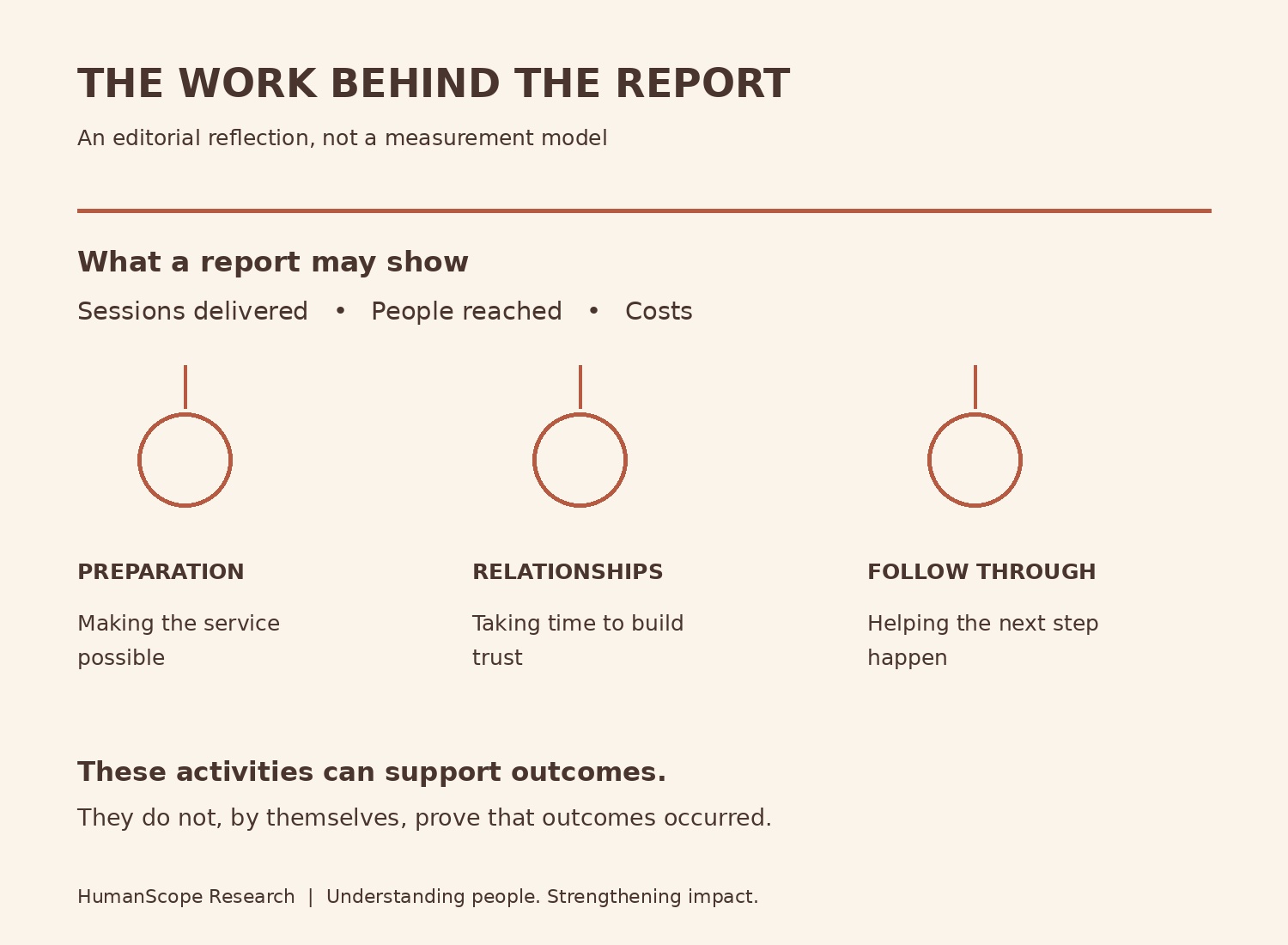
Preparing a room, explaining something again, arranging transport or following up a concern can feel ordinary to the people doing it. These activities can also be the difference between a service being available and someone being able to use it.
Not every task is an outcome. A phone call does not prove that a person is better supported. But leaving all the surrounding work out of the conversation can make delivery appear simpler than it is.
What would a reader misunderstand about this service if they saw only its attendance figures?
A report has a purpose, and a limit
Funders need clear information about how resources were used and what was achieved. A report cannot hold every conversation, and asking it to do so would create its own burden.
The question is whether the information gives a fair sense of the service, including the resources it depends on.
New Zealand’s External Reporting Board guidance recognises that service performance information may describe what an entity has done or the difference it has made. The appropriate emphasis depends on the entity. That wider perspective is useful when thinking about a funding report, although a grant report and a statutory performance report serve different purposes.
Read XRB guidance on service performance reporting

Quiet work still needs resources
Return to the imagined group. If its funding covers only the hour when people are in the room, the preparation and follow through still have to happen somewhere.
Perhaps staff absorb the time. Perhaps volunteers carry it. Perhaps some of it stops happening.
None of those possibilities is a finding about a particular organisation. They are reasons to ask whether the funded activity reflects the work required to deliver it responsibly.
For us, sustainability includes being able to sustain that surrounding work. A programme can look affordable on paper while relying on time that nobody has properly acknowledged.
Recognition without overclaiming
There is a temptation to turn every kind gesture into an impact story. We should resist that.
The volunteer’s welcome matters, but we cannot assume what it changed for the participant. Their own account may differ from the story we hoped to tell. They also have a right to keep parts of their experience private.
A thoughtful account can recognise the work, explain why it is part of delivery and remain honest about what is known. It need not turn someone’s personal life into promotional material.
What deserves to stay visible?
Next time a service is described as a set of sessions, consider what sits around those sessions. What helps people arrive? What supports them while they are there? What happens after they leave?
Those questions do not replace accountability. They help us discuss what it actually takes to offer a reliable service.
HumanScope Research helps community organisations connect evidence, service delivery and funding sustainability. We can begin with one programme or one immediate evidence need.
Register your interest in funding support
HumanScope Research. Understanding people. Strengthening impact.