
FUNDING AND SUSTAINABILITY · By HumanScope Research
The invitation is exciting. A new funder wants to support more sessions. Another neighbourhood would like your programme. The board can picture a bigger reach.
Then someone asks a quieter question: what would growing actually make possible for the people we serve?
There may be a very good answer. But a larger budget, a fuller calendar and a longer attendance list cannot answer it on their own.
More places at the table
Imagine a community food programme offered the chance to expand to another suburb. This is an illustrative example, not a client story. A second venue could help families who currently cannot travel to the first. That would be a meaningful reason to explore growth.
Now imagine that expansion draws the same small team away from the conversations that help families find other support. More meals might be served, while a part of the programme that people value becomes harder to sustain.
Neither possibility is a prediction. Together they reveal the question behind the opportunity: what are we hoping to increase, and what could become thinner?

Activity and change belong in the same conversation
New Zealand’s External Reporting Board makes a useful distinction in its service performance guidance between the services an entity delivers and the effects of its work. Its EG A10 guide also discusses quantity, quality and cost. This particular guide supports Tier 1 and Tier 2 reporting; smaller organisations have separate standards and guidance.
Read XRB’s service performance guide
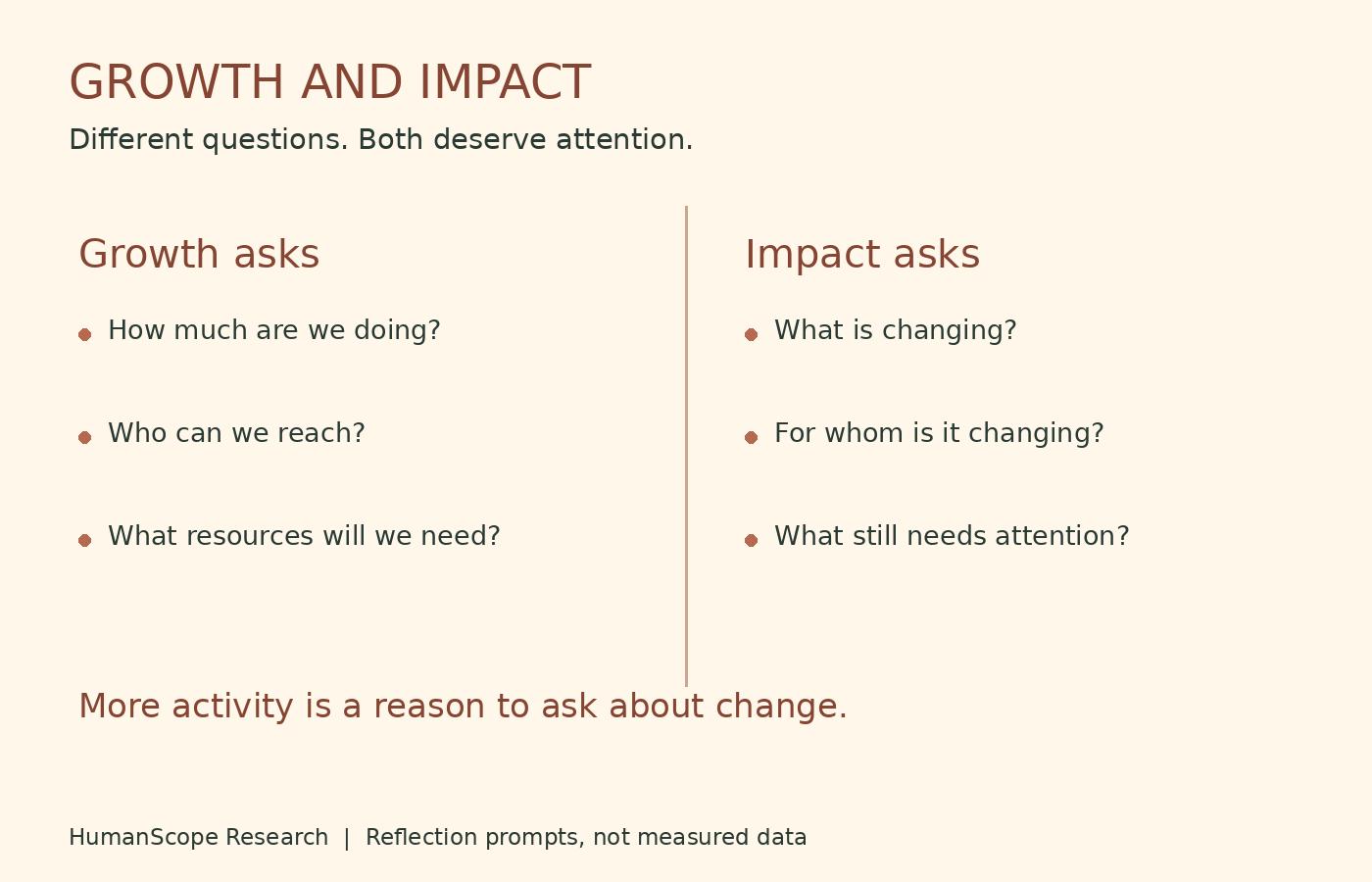
For this discussion, the broader idea is useful: describing more activity and understanding its value are related tasks. They are not interchangeable. Our reflection is that an expansion proposal deserves room for both.
A bigger grant can bring a bigger promise
Before celebrating the size of a funding opportunity, it is worth considering the promise attached to it. Will there be enough time to recruit and support people? Can the organisation maintain the relationships that made the original service useful? What happens to the existing programme while the new one takes shape?
These questions need not dampen ambition. They can give ambition somewhere solid to stand. Funding that supports the infrastructure of growth may feel different from funding that adds delivery expectations while leaving the same capacity underneath.
If growth succeeds on paper, what would we hope people notice in everyday life?
There is more than one way to move forward
Sometimes the most useful next step might be reaching a new community. Sometimes it might be making an existing service more accessible, strengthening quality or working alongside another organisation. The choice depends on purpose and evidence, rather than an assumption that bigger always means better.
A board does not need a perfect forecast to discuss this honestly. It does need space to ask what the opportunity serves, whose experience could improve and what must be protected along the way.
HumanScope connects funding research, evaluation and sustainability conversations so organisations can consider growth with a clearer understanding of the work they want to sustain. If an opportunity has raised these questions for your team, tell us what you are considering.
Register your interest in funding support
Visuals are illustrative. The infographic presents reflection questions, not research findings.