

FUNDING & SUSTAINABILITY • HUMANSCOPE RESEARCH
Five practical questions to help you choose funding that fits your mission, resources and future.
When your organisation needs funding, finding an open grant can feel like a welcome opportunity.
It is tempting to start writing immediately. There are services to sustain, bills to pay and people relying on your work.
Before investing time in an application, however, it helps to ask one question:
Would this funding support the work we need to do, and can we realistically deliver what it requires?
A funding opportunity deserves careful consideration. Here are five questions to help you assess it.
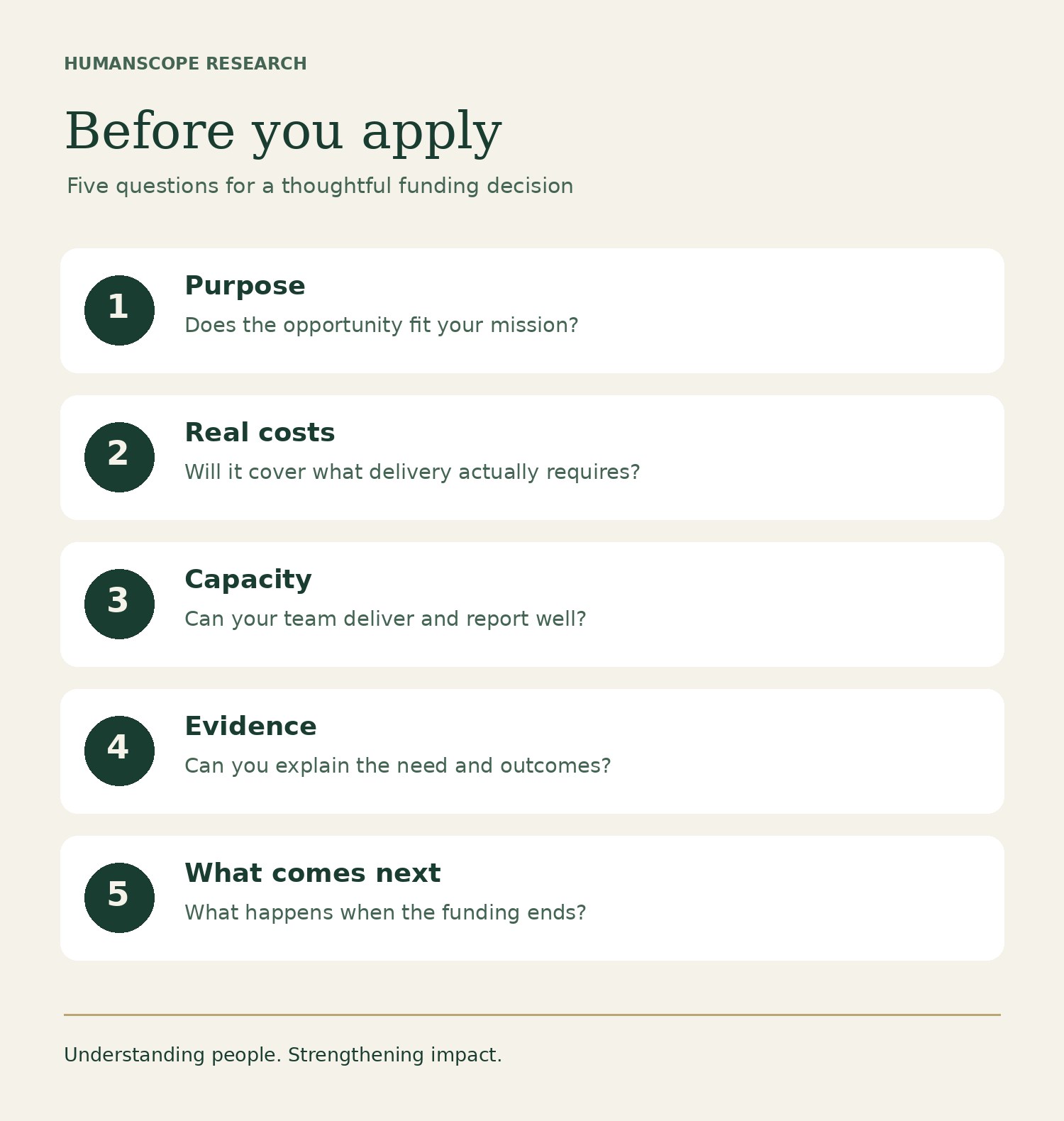
1. Does it fit your purpose?
Look beyond the grant title. Read the funder’s priorities, eligibility criteria and exclusions.
Can you clearly explain how your existing work, or a genuinely needed new project, aligns with what the funder wants to support?
If the connection requires you to substantially reshape your purpose, pause. A project can sound attractive on paper while drawing time and resources away from the community needs your organisation exists to address.
2. Will it cover the real cost?
A programme budget involves more than materials and delivery hours.
Depending on the work, you may also need coordination, administration, transport, venue hire, evaluation and reporting.
Check which costs the funder allows. If the grant covers only part of the project, identify how you will meet the remaining costs.
For example, a grant might fund a series of workshops but exclude the staff time needed to organise them. Your organisation still needs a workable way to cover that time.
An award can bring a financial commitment as well as financial support.

3. Do you have the capacity to deliver?
Consider who will manage the project, deliver the activities, track spending and prepare reports.
Will it depend on already stretched staff or volunteers? Are partner organisations available? Can you meet the proposed timetable?
These questions help you build a credible application and avoid committing to more than your team can sustain.
Where the opportunity allows it, a smaller, well planned project may be a practical starting point.
4. Can you explain the need and intended outcomes?
A clear proposal connects three things:
The need you have identified.
The work you propose to deliver.
The changes you hope that work will support.
Use relevant evidence: community feedback, service records, local research or insights from partner organisations. Explain where your information comes from and acknowledge gaps.
Then consider how you will assess progress. Choose a few useful measures that your team can realistically collect.
This preparation gives you a clearer project plan, whether or not the application succeeds.
5. What happens when the funding ends?
Some grants support a one off activity. Others help organisations test or establish a service.
Be clear about which you are proposing.
If the work needs to continue, consider its future costs and possible sources of support. If it is time limited, plan how you will communicate that to participants and bring the project to a responsible close.
You do not need to promise permanent delivery when the resources are uncertain.

Make a deliberate decision
Before applying, write a short assessment covering fit, costs, capacity, evidence and what happens afterwards.
You may decide to proceed, adjust the scope, seek a partner or leave the opportunity for another organisation.
Each can be a sensible decision. The aim is to pursue funding that helps your organisation deliver meaningful work on manageable terms.
Find funding that fits your next step
HumanScope Research supports organisations with funding landscape research, project needs assessments, outcome planning and evidence development, helping you build a clearer foundation for funding decisions.
Looking for funding that fits your organisation’s next step?
Register your interest in funding support →
HumanScope Research. Understanding people. Strengthening impact.