

RESEARCH AND COMMUNITY VOICES · By HumanScope Research
An organisation asks, “How satisfied were you with the programme?” The responses are positive. The team now knows that many people enjoyed what was offered.
But perhaps the community’s most important concern was never satisfaction. Perhaps it was whether the programme was accessible, whether it addressed the right need or whether something else would have helped more.
A question can invite a voice. It can also decide, quietly, which part of that voice will be heard.
Every question carries a frame
Imagine a youth service reviewing a holiday programme. This is an illustrative example, not a client story. Young people are asked which activities they liked best. They answer carefully, and the team identifies a clear favourite.
Later, an informal conversation reveals that transport made attendance difficult for several families. The original question was answered accurately. It simply was not designed to reveal that barrier.
This does not make the first question useless. It shows that a good answer can still belong to a narrow question.
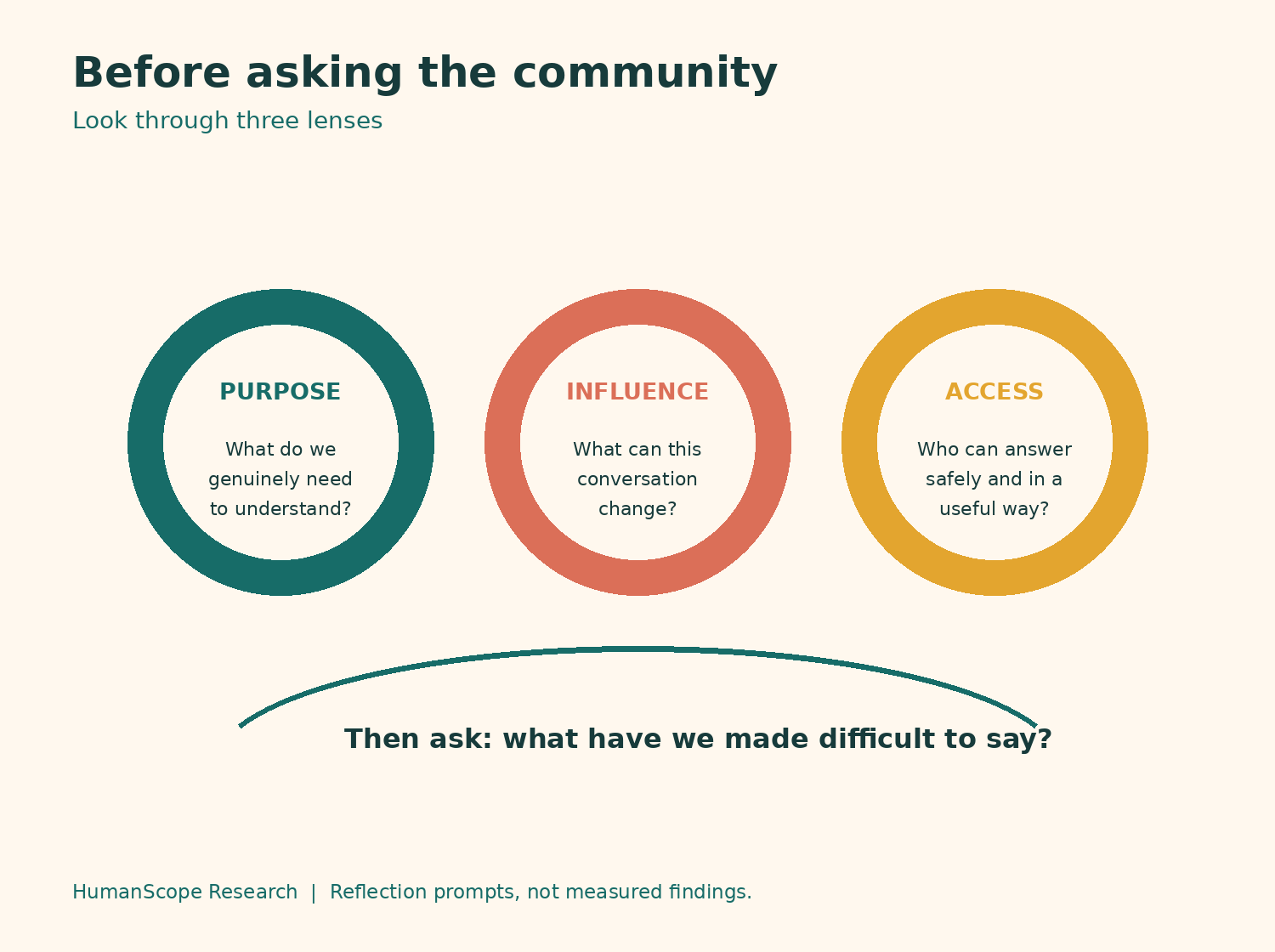
What decision will the answer influence?
Before asking a community for input, it helps to be clear about what remains open. Can people influence the programme’s purpose, its delivery or only a small choice within an existing plan?
The Department of the Prime Minister and Cabinet says engagement should be designed with a clear promise about the level of influence on decision making, with methods that reflect that promise. Its guidance is written for government policy practice. The principle offers a useful reflection for community organisations too: are we honest about what the conversation can change?
Read the Department of the Prime Minister and Cabinet engagement guidance
Are we asking for input on a decision that has already been made?
A familiar question may not be an accessible question
The words may be clear to the person who wrote them and still feel unfamiliar to someone else. A question about outcomes, wellbeing or service quality may carry professional meanings that are not shared by participants.
Language is only one part of accessibility. Timing, trust, privacy, cultural context and the way the question is asked may affect what a person feels able to say. The person who answers quickly and confidently cannot automatically speak for everyone.
The Public Service Commission describes responsiveness as taking time to listen and understand people’s circumstances and needs, and as collaborating meaningfully so services meet people’s needs and aspirations. This standard applies to the Public Service. It also offers a useful prompt for any organisation seeking community views.
Read the Public Service Commission guidance on responsiveness

Leave room for a different question
In the imagined youth programme, asking which activity was preferred could support next term’s timetable. Asking what made participation easier or harder could support a different decision. Inviting young people to identify what the team has not asked might reveal another direction again.
These questions are not interchangeable. The useful one depends on what the organisation genuinely wants to understand and what it is prepared to reconsider.
There may also be no single community answer. Different people can want different things for sound reasons. Listening well does not guarantee agreement. It can make those differences visible before a decision is presented as shared.
The quality of the answer begins earlier
When an organisation receives little useful feedback, the problem may not be that people have nothing to say. It may be worth looking at the invitation, the relationship and the shape of the question.
Before the next survey or consultation, pause over one sentence. What does this question allow someone to tell us? What does it make difficult to say? And who had a hand in deciding that this was the question worth asking?
HumanScope supports community research, evaluation and outcomes work that helps organisations connect their questions with the decisions they need to make. If your team wants to hear community perspectives more clearly, we welcome an enquiry.
Register your interest in research and outcomes support
HumanScope Research. Understanding people. Strengthening impact.
Images are conceptual paper collage illustrations. The infographic presents reflection prompts, not research findings. Sources checked 7 October 2026.